
In many ways, Northern Renaissance Art is a very small mirror that reflects a whole room. To me, it appears to be a garden filled with bizarre, unreal creatures, and somewhere there is a skull hidden inside a portrait. From the mid-1400s through the late 1500s, European artists took ordinary items or ideas and turned them into visually extraordinary experiences.
The Northern Renaissance was different from the Italian Renaissance. While the Italian artists mostly portrayed the classic ideal of beauty, the Northern artists were more interested in portraying the details of clothing, how light moves across a surface, how people express themselves, and everyday objects. However, their paintings frequently had more religious, moral, wealth and mortality messages.
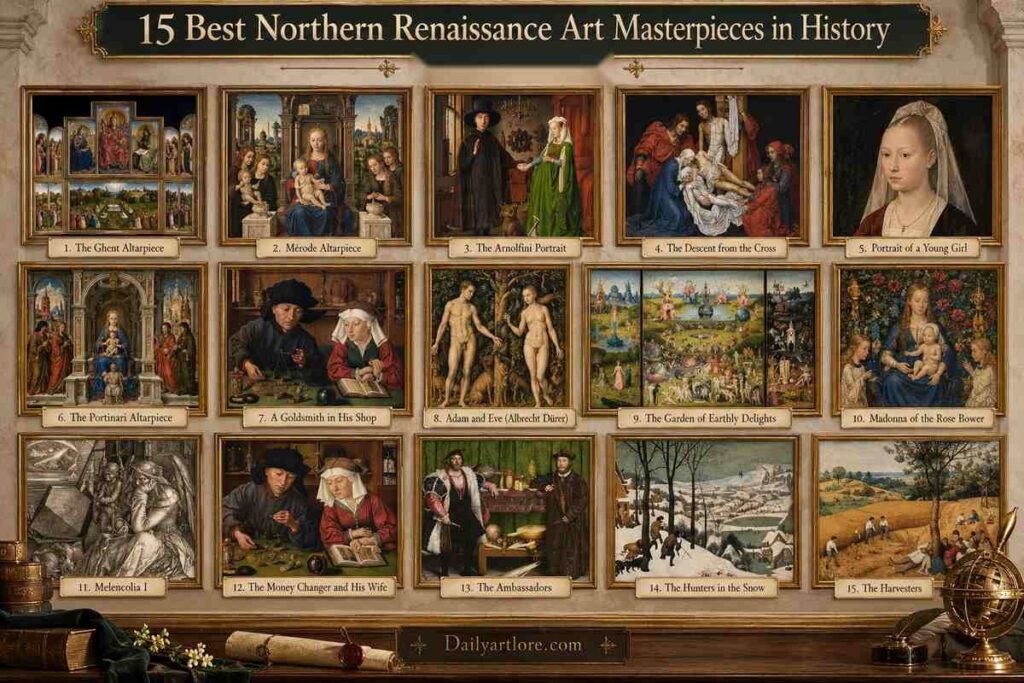
These 15 masterpieces reflect the evolution of Northern Renaissance Art over the centuries and its legacy today. Yeah, from Jan van Eyck’s remarkable portraits to Hieronymus Bosch’s unsettling fantasies, their influence endures today.
What Is Northern Renaissance Art?
Northern Renaissance Art is a term used to describe the art that was produced in the Low Countries (Belgium, Netherlands), Germany, and some regions of France during the 15th and 16th centuries.
The movement’s goals were similar to those of the Renaissance (observation and human experience). However, the artists from the North developed their own style of working. The artists from the North were able to create very sharp surfaces, realistic lighting, expressive portraits and highly detailed religious stories.
In addition to this, the art of oil painting has advanced and enabled the artists to develop multiple layers of color that are transparent, as well as produce fine textures in their paintings. Furthermore, with the help of printmaking, images have been able to spread outside of the artist’s workshop.
Key Characteristics of Northern Renaissance Art
The following list includes some of the artistic characteristics that distinguish the great works of art of the Northern Renaissance from other periods.
- Extraordinary realism: Artists carefully represented skin, hair, clothing, glass, and polished metal.
- Oil painting techniques: Layered colors created luminous surfaces and subtle transitions.
- Religious symbolism: Familiar objects sometimes carried spiritual or moral associations.
- Detailed landscapes: Natural environments became increasingly important to composition and storytelling.
- Individual portraiture: Artists captured distinctive faces, personalities, and social identities.
- Everyday life: Domestic interiors, markets, workers, and village activities entered major artworks.
- Innovative printmaking: Woodcuts and engravings circulated images and artistic ideas across Europe.
Nevertheless, each of these characteristics varied significantly among individual artists and across historical periods. For instance, while van Eyck’s observation is controlled, Bosch’s imaginary worlds are very different.
15 Famous Northern Renaissance Artworks in History
The following highlights are of paintings, religious panels, portraits and prints of Northern Renaissance Art and reflect the great variety of this art period.
1. The Ghent Altarpiece – Hubert and Jan van Eyck (1432)
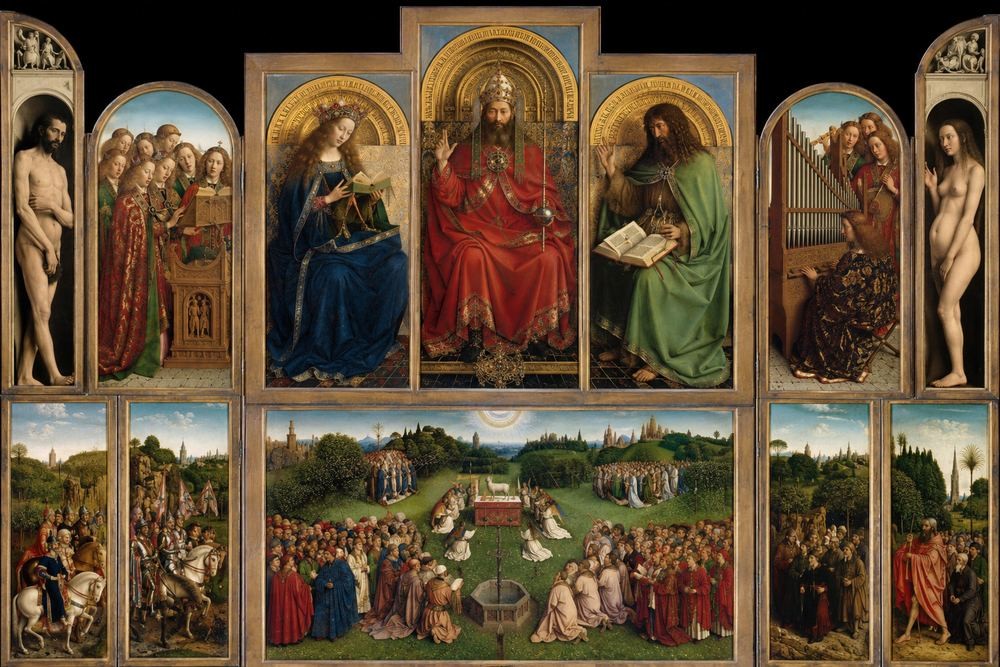
Location: St. Bavo’s Cathedral, Ghent, Belgium
Few other pieces of art with a religious theme have as much visual richness as The Ghent Altarpiece, or The Adoration of the Mystic Lamb.
This large-scale polyptych was completed in 1432. It depicts biblical figures, very detailed landscapes, and an exceptional amount of focus on surface detail. The central panel is a depiction of people gathering around the Lamb of God, which is a symbolic representation of Christ’s sacrifice.
Observe the jewelry, apparel, foliage and architecture in the painting. Each area demonstrates how the artist created a believable environment through paint, as well as how to communicate religious ideas.
The altarpiece also demonstrates the potential of early Netherlandish art. The artist has created a visually complex piece that encourages the viewer to consider how the world we live in relates to God.
Why it matters: The work continues to be an important example of the first use of oil painting by artists working in the Netherlands. Yeah, it is an important example of how early Dutch painters used imagery to tell biblical stories.
2. The Mérode Altarpiece – Robert Campin and Workshop (c. 1427–1432)
Location: The Metropolitan Museum of Art, New York
The Mérode Altarpiece is reminiscent of a domestic interior at first sight. But its focus is the Annunciation, the announcement by the angel Gabriel that Mary will give birth to Jesus.
The painter does not set the action in a large church but in a “homey” interior, which is furnished. Mary is surrounded by a book, a vessel, flowers, and objects around her.
As a result, the sacred narrative seems to be quite near to the viewer’s world. The side panels add other figures and activities, linking the biblical scene with contemporary life. It is also lavishly furnished in detail, which calls into question the purity, devotion and Incarnation.
Why it matters: The painting demonstrates the way in which northern artists translated religious stories into familiar terms of home.
3. The Arnolfini Portrait – Jan van Eyck (1434)
Location: National Gallery, London
Two elegantly dressed individuals are standing inside a lavishly decorated room. Behind them, a small convex mirror reflects the interior and two additional visitors.
The Arnolfini Portrait’s use of such an extraordinary feature has made it one of the most talked-about works of art from the 15th Century.
Jan van Eyck meticulously renders the texture of fabrics, the sheen of polished metal, the details of wooden furniture, and the subtle play of light on reflective surfaces. In addition to these elements, items like oranges and high-end furnishings indicate a wealthy household.
Scholars have historically understood the scene to depict a marriage. That interpretation has been questioned, and there are many items in the scene that are still open to interpretation. The woman’s large dress does not necessarily indicate she is pregnant.
Why it matters: The extraordinary illusionism of this painting clearly shows how far advanced technically the artists of the Northern Renaissance were at that time. Additionally, because the subject matter of the painting has not yet been deciphered, there will always be a lively discussion among scholars about what it means.
4. The Descent from the Cross – Rogier van der Weyden (c. 1435)

Location: Museo Nacional del Prado, Madrid
Grief dominates Rogier van der Weyden’s The Descent from the Cross.
The image displays Christ’s body being removed from the cross. However, many of those who are mourning show great emotions through their facial expressions and gestures. Mary is collapsing due to her extreme grief, which can be seen in the way that she falls to the ground. This physical fall mirrors the position of Jesus’ dead body.
As opposed to a dense and extensive landscape story, the characters in this work are contained within a tight, flat area. This placement enhances the emotional connections between them and draws attention to the human suffering depicted.
The arrangement of the hands, the way the clothing is draped over them, and the curves formed by the drapes all combine to create a rhythmic pattern within the entire composition.
Rather than being primarily concerned with realistic portrayal of physical forms, van der Weyden uses facial expressions, body movements and positioning of figures in order to convey the emotional immediacy of religious devotion.
Why it matters: Because it illustrates that Northern painters were capable of combining detailed observations with an unusual amount of religious fervor.
5. Portrait of a Young Girl – Petrus Christus (c. 1470)
Location: Gemäldegalerie, Berlin
The young woman is looking directly at the camera. Her composed facial expression gives little clue to what she is thinking.
The quiet intensity of Petrus Christus’s portrait of a young girl is what makes it so distinctive. Her meticulously coiffed hair, elegant dress and fair skin stand out from the simple backdrop.
In place of using dramatic movement, the artist creates a sense of curiosity through the subtle way in which they render the subject’s face, along with the obvious personality of the individual being painted.
This picture is another example of a growing desire to portray individuals who are different from traditional religious subjects. Unfortunately, the identity of the person depicted in the painting is still unidentified.
The directness of her gaze makes me feel as though we are having a conversation, and the size of the canvas makes this small piece seem very contemporary.
Why it matters: This portrait illustrates the progression of individual likeness and psychological presence in early Netherlandish painting.
6. The Portinari Altarpiece – Hugo van der Goes (c. 1475–1478)
Location: Uffizi Galleries, Florence
Hugo van der Goes made the Nativity a very detailed picture of devotion.
The Infant Christ rests on the earth at the core of this scene, with his Mother Mary, Father Saint Joseph, angels and shepherds surrounding him. Their faces reflect a variety of emotions, including awe and wonderment.
Meanwhile, the carefully painted flowers in the foreground may contain a potential religious meaning, such as the concepts of purity and suffering.
The commission of this work came from Tommaso Portinari, an Italian (Florentine) bank manager working in Bruges, Belgium. When the work arrived in Florence, Italy, it exposed Italians to the painting styles used in Northern Europe.
In fact, the elaborate features of the subjects and the brightness of their skin show us another way of working compared to the idealistic images that we frequently associate with Renaissance Italy.
Why it matters: The altarpiece serves as a key illustration of the exchange of artistic ideas between Northern Europe and Italy.
7. A Goldsmith in His Shop – Petrus Christus (1449)
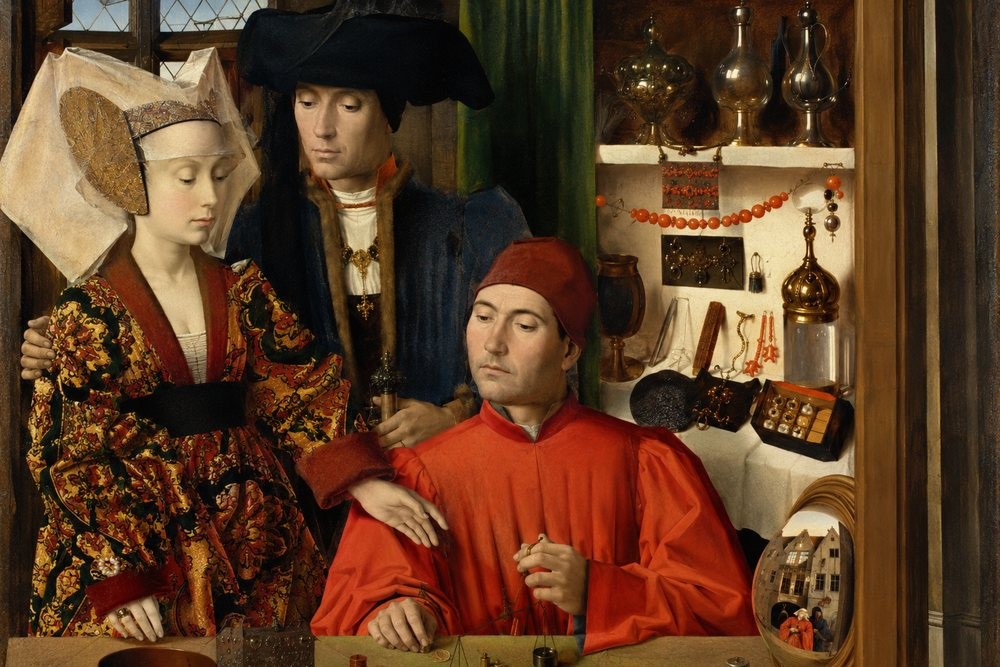
Location: The Metropolitan Museum of Art, New York
A goldsmith is working on a tiny piece of jewelry at his counter with two customers standing next to him, who are both dressed up.
The painting shows an interesting assortment of high-end items such as jewelry, containers, and valuable materials. It seems that every part of the image has been studied closely.
The topic of this discussion is much larger and more complex than simply a picture of a store. Traditionally, it was believed that the person depicted in the painting was Saint Eligius, the patron saint of goldsmiths. However, there is no agreement regarding what precisely is represented by the image.
A convex mirror in the front of the image is used to draw attention to what lies beyond the two main figures. These details are used by Christus to connect work (craftsmanship), money (wealth) and who you are socially (social identity).
Why it matters: This painting illustrates the connection between highly detailed realistic visual representations and the business-oriented cultures of Northern Europe.
8. Adam and Eve – Albrecht Dürer (1504)
Medium: Engraving
Notable collection: The Metropolitan Museum of Art, New York
Albrecht Dürer’s “Adam and Eve” utilizes Renaissance-era concepts of human proportion within a Biblical context.
The print shows the first two human beings next to the Tree of Knowledge with many animals and very detailed plant life all around.
Dürer used both the study of proportions and the idealization of classicism in developing his own unique way of working as an artist. Thus, the representation of the body in Dürer’s work shows how he attempted to combine the concept of the perfect human body with the traditional use of detail in Northern Europe.
In addition to being linked with historical theories regarding the four temperaments, these animals are also connected. Unlike an oil painting, this image was created with very precise control of the engraved lines that create a great sense of depth.
Why it matters: This shows that the art of the Northern Renaissance extended beyond painting to include printmaking and studies of ideal human proportions.
9. The Garden of Earthly Delights – Hieronymus Bosch (c. 1490–1500)
Location: Museo Nacional del Prado, Madrid
Bosch’s painting, “The Garden of Earthly Delights,” is one that raises more questions than most other paintings.
Viewers are presented with a truly unique world that contains an array of unusual animals, extraordinarily large fruits, strange architecture, and disquieting human actions through the use of three separate panels.
The left side shows a paradise, the middle is filled with people doing strange things, and the right side is filled with evil punishment and crazy inventions.
Although scholars still disagree on what exactly the triptych’s intended audience was, they do agree that it has been viewed by many as a warning about the consequences of sin.
In addition to being decorative, the imaginative elements of Bosch’s work provide opportunities for viewers to ponder topics such as desire, temptation, spiritual risk, and the actions of humans.
Why it matters: The work continues to be one of the most imaginative and mysterious accomplishments in all of European art history.
10. Madonna of the Rose Bower – Stefan Lochner (c. 1440–1442)

Location: Wallraf-Richartz-Museum, Cologne
The Madonna of the Rose Bower by Stefan Lochner depicts the Virgin Mary and her baby Jesus as part of a small group of angels and roses.
The combination of bright colors, well-crafted facial expressions, and complex decorations creates a visually striking work. The use of gold enhances the sacredness of the image by evoking the art of the Middle Ages.
The enclosed garden and roses are traditionally connected to Marian imagery. Lochner’s work is characterized by an emphasis on spiritual serenity and gentleness rather than a pursuit of dynamic action.
Northern Renaissance painters demonstrated a balance of both beauty in decoration and close attention to detail, which shows how they were influenced by prior regional traditions rather than casting them aside entirely.
Why it matters: This piece of art demonstrates how late-medieval religious images influenced early-Renaissance naturalistic techniques.
11. Melencolia I – Albrecht Dürer (1514)
Medium: Engraving
Notable collection: The Metropolitan Museum of Art, New York
A flying being is seated in silence, surrounded by mathematical instruments, tools, and other mysterious objects.
In Dürer’s “Melencolia I,” intellectual success is strangely linked with frustration and uncertainty.
The figure is surrounded by a geometric solid, an hourglass, measuring instruments, and a numbered square. There has been much scholarly debate regarding the significance of these items.
The engraving may raise issues regarding the relationship between the creative process, knowledge, and what an artist is capable of achieving through their work.
The extraordinary use of lines in Dürer’s engravings allows him to create believable textures and atmospheric contrasts with no use of color. The result feels both analytical and deeply emotional.
Why it matters: This work of art exemplifies the intellectual pursuit and symbolic intricacy found within the realm of Renaissance printmaking.
12. The Money Changer and His Wife – Quentin Matsys (1514)
Location: Louvre Museum, Paris
A money changer carefully examines coins while his wife looks away from her devotional book.
A money changer inspects the coins, as his wife turns away from reading her prayer book.
Quentin Matsys shows us a small room where money-changing takes place, but also where religious thought occurs. Therefore, the picture makes you think about how money relates to our responsibilities to God.
The coins, balance, jewelry and other objects are depicted using an amazing amount of care for detail.
On the other hand, viewing this image as an indictment of avarice is to simplify a much larger issue. The images could provide us an opportunity to consider how to find a balance between our fiscal obligations and our ethical principles.
This tension is particularly interesting in relation to Northern Europe’s rapidly developing commercial economy.
Why it matters: This connection between the tradition of Northern Renaissance Art and the new concern for commercialism, ethics, and the daily lives of people.
13. The Ambassadors – Hans Holbein the Younger (1533)
Location: National Gallery, London
The wealthy men are standing next to shelves that hold a variety of items such as scientific equipment, literature, and music-related objects.
In its early stages, Hans Holbein’s painting titled “The Ambassadors” seems to praise learning, social position, and intellectual interest.
In front of you is an unusual, long-shaped object that can be seen as a human skull when viewed at the right angle. The use of this visual technique (anamorphosis) is a strong reminder of our own mortality.
The items found on the ground in front of the people indicate that they were scientific achievements but also reflected religious and political problems.
While the broken lute string can suggest discordance, the interpretation of each symbol requires careful consideration.
Why it matters: Hans Holbein the Younger created a masterpiece that combines portraiture, mathematical deception, and moral consideration into a single work of art.
14. The Hunters in the Snow – Pieter Bruegel the Elder (1565)
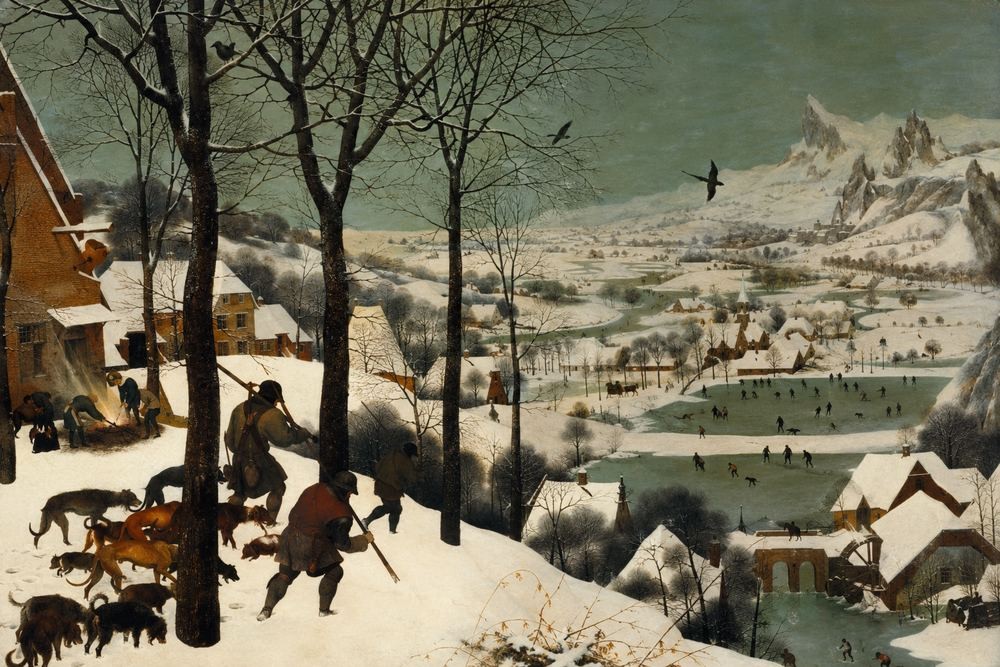
Location: Kunsthistorisches Museum, Vienna
Three men who were hunting, along with their dogs, come back over a snow-covered area where they can see down to the frozen town below.
Bruegel’s “Winter” is captured by using subdued color tones, a long view of the landscape with distant mountains, naked trees, and tiny people participating in the usual wintertime pursuits.
While the hunters are in the forefront, the huge expanse of land also has a major impact.
People are skating, working and gathering together in this scene. This creates a vibrant picture of how people live as a community during the winter months.
In addition, the high vantage point enables viewers to investigate many individual stories and still maintain the overall sense of unity within the work.
The painting is an expression of the natural cycle of everyday life and the world around us rather than being a representation of large-scale religious stories.
Why it matters: This was instrumental in establishing landscape and seasonal activity as important themes in European painting.
15. The Harvesters – Pieter Bruegel the Elder (1565)
Location: The Metropolitan Museum of Art, New York
Golden wheat fields extend toward a distant village while workers harvest crops under the summer sun.
The long rows of golden wheat are directed toward a remote village. At the same time, people who work on the land are harvesting their crops during the hot months of summer.
The individuals who are working hard with their equipment are the first group of people. The second group of people is those who sit under a tree, eat together, and take some time off from their job.
Bruegel does not present his characters as idealised heroes; rather, he depicts the physical hardships and common joys of country living.
The composition belongs to his celebrated series depicting seasonal activities.
Furthermore, the vastness of the land underscores people’s relationship to both the natural world and the seasons of agriculture.
Bruegel’s emphasis on representing common people at work was a way for him to expand the potential subjects that could be included in Renaissance art.
Why it matters: The Harvesters shows us how much more relevant landscape, daily life and the countryside became during the Northern Renaissance.
Read Also: 12 Most Famous Medusa Artworks Through Art History
Northern Renaissance vs. Italian Renaissance: What Was Different?
Both movements transformed European art, but their methods and priorities often differed.
Italian Renaissance artists frequently explored classical architecture, idealized anatomy, monumental composition, and mathematical perspective. Northern painters, meanwhile, became particularly celebrated for their detailed surfaces, luminous oil techniques, and convincing representations of everyday objects.
For example, compare van Eyck’s domestic interiors with Raphael’s carefully balanced classical compositions. Their visual approaches differ, yet both demonstrate sophisticated observation and artistic planning.
However, the distinction should not be exaggerated. Italian painters also created detailed portraits, while northern artists studied human proportions, perspective, and classical forms.
In fact, Dürer traveled to Italy, and northern works such as the Portinari Altarpiece influenced artistic developments beyond their places of origin.
Therefore, Northern Renaissance Art is best understood as part of a wider European exchange rather than an isolated alternative to the Italian Renaissance.
Why Did Northern Renaissance Art Change European Painting?
Its influence came from more than impressive technical skill.
First, increasingly sophisticated oil painting allowed artists to produce subtle lighting effects and varied textures. Next, the growing importance of portraits and domestic subjects expanded the range of stories that pictures could tell.
Furthermore, engravings and woodcuts brought artistic ideas to audiences who might never visit a major church or wealthy collector’s residence.
Religious changes, urban prosperity, and international trade also shaped artistic production.
Above all, these developments encouraged painters to explore the relationship between visible reality and deeper meaning.
The influence of Northern Renaissance Art can therefore be traced through later developments in portraiture, landscape painting, still life, and genre scenes.
Final Thoughts
A mirror, a broken musical string, or a field of wheat might appear ordinary. Yet Northern Renaissance masters transformed such details into memorable artistic experiences.
Their achievements cannot be reduced to realism alone. Religious devotion, intellectual curiosity, social change, and imaginative storytelling all contributed to the movement’s remarkable diversity.
From van Eyck’s luminous interiors to Bosch’s unsettling visions and Bruegel’s expansive landscapes, Northern Renaissance Art continues to reward close observation.
Perhaps its greatest achievement lies in showing that everyday reality can be just as compelling as an imagined or ideal world.
FAQs About Northern Renaissance Art
Who were the most famous Northern Renaissance artists?
Jan van Eyck, Rogier van der Weyden, Albrecht Dürer, Hieronymus Bosch, Hans Holbein the Younger, and Pieter Bruegel the Elder are among the movement’s most influential figures. However, many other artists contributed to its development across different European regions.
What is the most famous Northern Renaissance painting?
There is no universally accepted answer. Nevertheless, The Arnolfini Portrait, The Garden of Earthly Delights, and The Ghent Altarpiece are among its most widely recognized masterpieces.
Did Northern Renaissance artists invent oil painting?
No. Oil-based techniques existed before the fifteenth century. However, painters such as Jan van Eyck helped refine their use and demonstrated their extraordinary potential for creating luminous, detailed images.
Why was symbolism important in Northern Renaissance paintings?
Religious beliefs, moral traditions, and cultural practices shaped how viewers understood painted objects. Still, not every object necessarily carries a hidden message, and many interpretations remain debated.
Where can you see famous Northern Renaissance masterpieces?
Important collections include London’s National Gallery, Madrid’s Prado Museum, New York’s Metropolitan Museum of Art, Berlin’s Gemäldegalerie, Vienna’s Kunsthistorisches Museum, and Ghent’s St. Bavo’s Cathedral.