
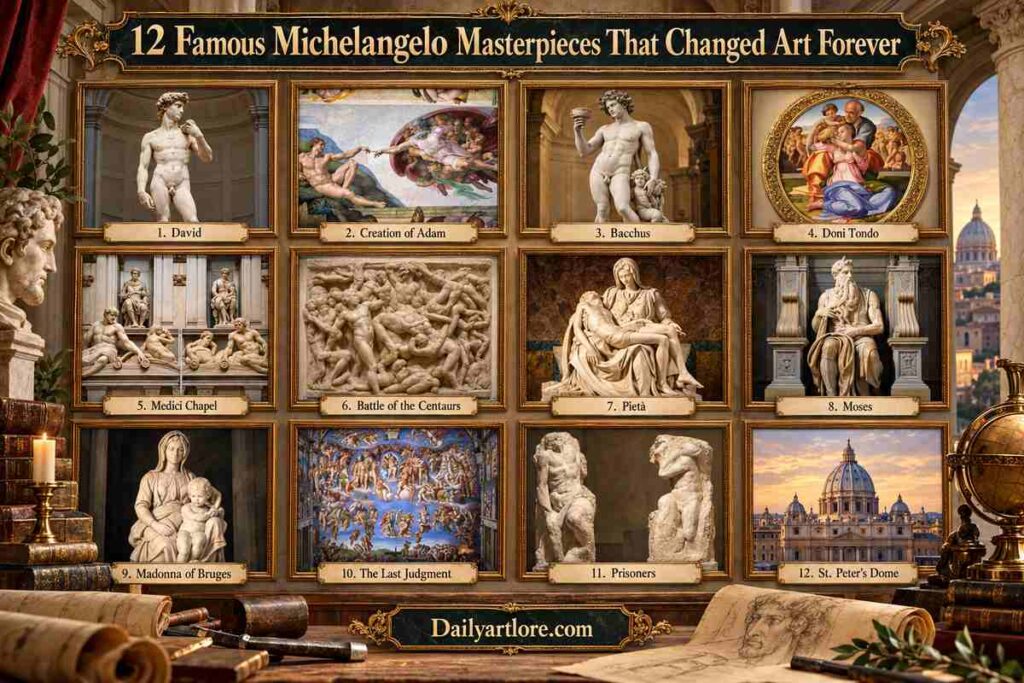

A monument of marble looms over the streets of Florence, gazing down upon passersby and seeming almost human. A pair of painted hands stretch across a bare space and meet a second pair, creating one of the most famous images in art history. Both say something about Michelangelo: his talent, in which physical form becomes a narrative.
The artist Michelangelo Buonarroti was born in 1475. Yeah, it is an iconic name of the Italian Renaissance. The sculptures, frescoes and architectural designs were a complete transformation of what could be expected of artists.
However, his oeuvre was not just about brawny bodies or technical skill. His career was defined by religious devotion, political ambition, personal struggle and creative experimentation. Below, I’ll provide 12 famous Michelangelo masterpieces that reveal different sides of his artistic imagination, from youthful experiments in marble to monumental achievements in the Vatican.
What Makes Michelangelo’s Art So Important?
Michelangelo was a sculptor, painter, architect and poet who worked throughout the High Renaissance to Mannerism. Although he was successful in a variety of genres, the role that sculpture played in his understanding of artistic form was fundamental.
His figures are rarely the epitome of relaxation. Even muscular tensions, twisting bodies and gestures point to things words cannot express. Even his paintings appear sculptural, with concrete forms positioned in forceful locations of intentionally arranged images.
Several characteristics distinguish Michelangelo’s work:
- Realistic anatomy:Muscles, bones and human proportions give life-like figures.
- Emotional pitch:Characters speak through facial expressions and body language, often conveying not just emotion but also tension, grief, courage & devotion.
- Classical influence:Ancient Greek and Roman sculpture influenced his idealized vision of beauty.
- Monumental scale:He made small characters have presence even amid enormous built environments.
- Active narrative:The twisting bodies and dramatic poses direct the viewer through elaborate narratives.
- Raw surfaces:Several sculptures expose the counterpoint between unfinished stone and emerging human shapes.
In addition, Michelangelo’s accomplishments came at a time when artists were being recognized as more than just highly skilled people. But they were seen to have moved into the realm of intellectuals and creative thinkers.
12 Famous Michelangelo Masterpieces in Art History
Michelangelo masterpieces encompass biblical figures, classical narratives, unfinished creations and grandiose urban projects. Instead of tracing the path of his career in chronological order, this selection looks at contrasting examples of his artistic techniques and concepts.
1. David – Michelangelo (1501–1504)

Location: Galleria dell’Accademia, Florence, Italy. Medium: Marble sculpture
David is one of Michelangelo’s unique masterpieces. If not the only, it is one of the Renaissance sculptures that stirs emotion. The biblical hero towers above at more than five meters tall, but instead looks ready and alert rather than triumphant. His brow is furrowed, his eyes narrowed, and the strap hanging across his shoulder indicates that a confrontation is just around the corner.
In most earlier representations, David is shown with an expression of contentment after slaying Goliath; in Michelangelo’s version of the story, David has not yet killed Goliath. It turns the sculpture itself into an experiment in waiting, psychology, and physical preparation.
The ungiant hands and head make sense when we also take into account that the statue would be raised high on Florence Cathedral. But rather, the finished sculpture went on display in front of the city hall in 1504. It was in Florence that David’s image became linked to republicanism and the city of Florence’s determination to oppose its aggressors.
Why it matters: David combined the lesson of classical anatomical beauty with an assertion of civic identity and psychological tension, correcting what a monumental Renaissance sculpture could communicate.
2. The Creation of Adam – Michelangelo (c. 1511)
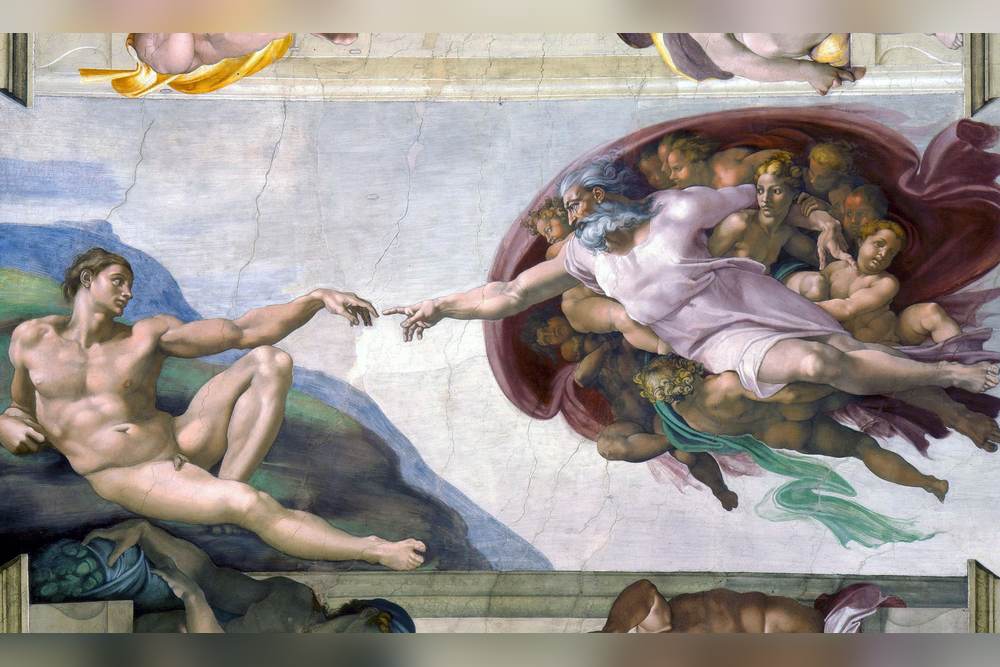
Location: Sistine Chapel, Vatican City. Medium: Fresco
The Creation of Adam features two arms stretched out, but the hands never clasp. It is this slight separation that imbues the painting with a rare anticipation. The setting is the ceiling of the Sistine Chapel, commissioned by Pope Julius II.
Michelangelo designed the grander scheme for the ceiling between 1508 and 1512, with biblical stories among prophets, sibyls, and other monumental figures. Adam lies on the ground like someone waiting to be returned to life. God comes winged, with people and drapes. Human activity is compared to passivity and divine action.
Oddly, Michelangelo eschews intricate landscapes or ornamental distractions. The entire story, rather, revolves around bodies, movements and the connection of two hands. Others even read the adjacent forms as symbols that hold larger anatomical or philosophical significance. Still, these theories are not universally accepted facts.
Why it matters: This fresco took a biblical moment outside of itself and turned it into an image. Now universally linked to creation itself, human potential, and humanity’s relationship with the divine.
Read More: 12 Most Famous Medusa Artworks Through Art History
3. Bacchus – Michelangelo (1496–1497)

Location: Museo Nazionale del Bargello, Florence, Italy. Medium: Marble sculpture
Michelangelo’s Bacchus fits his classical god a bit too unsteady. The artist portrayed a youthful god whose swaying stance is evidence of inebriation instead of sewing a flawless form together. The Roman god of wine holds a drinking vessel and grapes; to his side, there appears a small satyr. His head tilts, his stomach gives in, and his weight is unsure.
These facts are important, in part because Renaissance artists often looked to ancient sculpture in order to appreciate its symmetrical balance and idealised physical beauty. Michelangelo was well-versed in those traditions but opted for bodily fragility and frivolous imbalance.
It was created when he was still a newcomer to Rome,e and impressionable young artists were being deeply inspired by classical sculptures. Furthermore, its content shows that the imagination of Michelangelo went well beyond biblical subjects into the mythology and art history of classical antiquity.
Why it matters: Bacchus proved that Michelangelo could transform ancient sculpture into a modern interpretation, not just an idealization of classical style.
4. Doni Tondo – Michelangelo (c. 1505–1506)

Location: Uffizi Galleries, Florence, Italy. Medium: Tempera grassa on wood
While Doni Tondo may seem at first glance to be a brightly coloured version of the Holy Family, the uncommon positioning of its figures, however, sets it apart from more typical works of religious art.
Mary faces backwards to take the Christ Child from Joseph. The series of bodies intertwined becomes a compressed composition that almost exceeds the limits of the circle forming the painting. Michelangelo painted it for the Florentine merchant Agnolo Doni. It reveals his fascination with anatomy, movement and classical art through the use of sculptural forms and intense colors in the painting.
To the rear of the Holy Family are several nude figures in their own rectangle. They are often linked to humanity prior to Christianity; however, their exact meaning is still up for debate. The beautiful original frame also adds a touch of richness to the artwork. Uffizi also states that Doni Tondo is the only known completed panel painting of Michelangelo’s to survive.
Why it matters: Doni Tondo shows how Michelangelo incorporated a sculptor’s comprehension of corporeal substance into painting, paving the way for later Mannerist investigations.
5. The Medici Chapel Sculptures – Michelangelo (1520s–1530s)
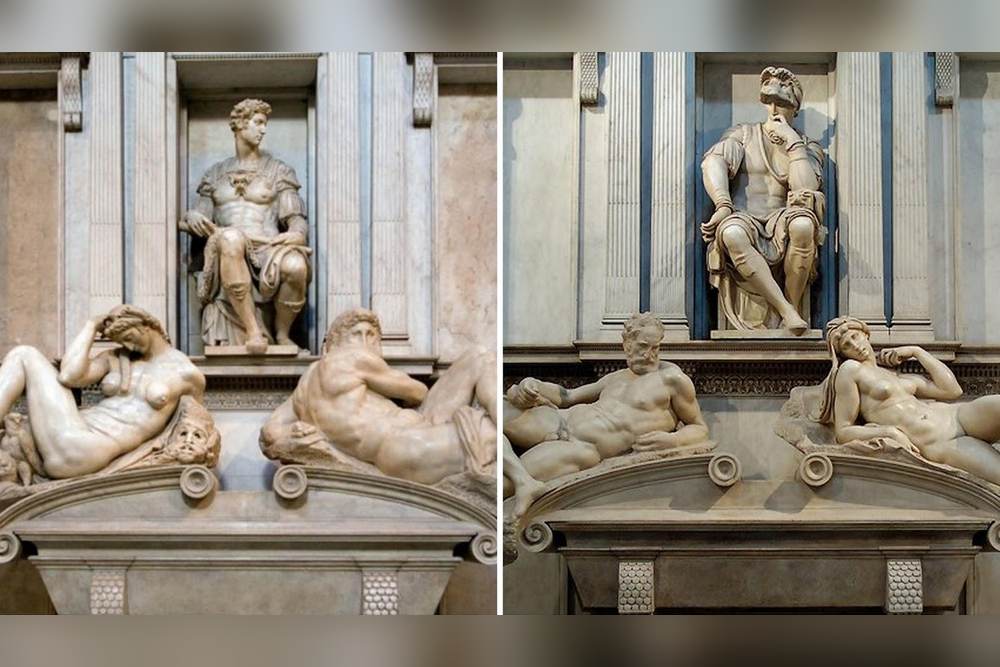
Location:.New Sacristy, Basilica of San Lorenzo, Florence, Italy. Medium: Marble sculpture and architectural design
In the Medici Chapel in Florence, Michelangelo turned family tombs into a stunning meditation on time and death. There were four recumbent allegorical personifications representing Day, Night, Dawn and Dusk. Their brawny bodies are strung out along the rounded forms of ancient tombs, so vivid they seem to be in motion despite being chiseled stone.
Night seems at rest, as do symbolic animals and things. Dawn is perhaps reluctant to wake, as though the act of being conscious at all had become a chore. Sitting above the tombs are idealized effigies of Giuliano, Duke of Nemours & Lorenzo, Duke of Urbino.
Instead of simply being portraits, the figures help to create a larger meditation on earthbound status and transience. Interestingly, Michelangelo designed the sculptures and their architectural context. This transforms the chapel from a room with randomly placed monuments into a cohesive artistic space.
Why it matters: The Medici Chapel puts together architecture, anatomy and philosophical symbols for Michelangelo in a stunningly whole experience of human mortality.
6. Battle of the Centaurs – Michelangelo (c. 1490–1492)
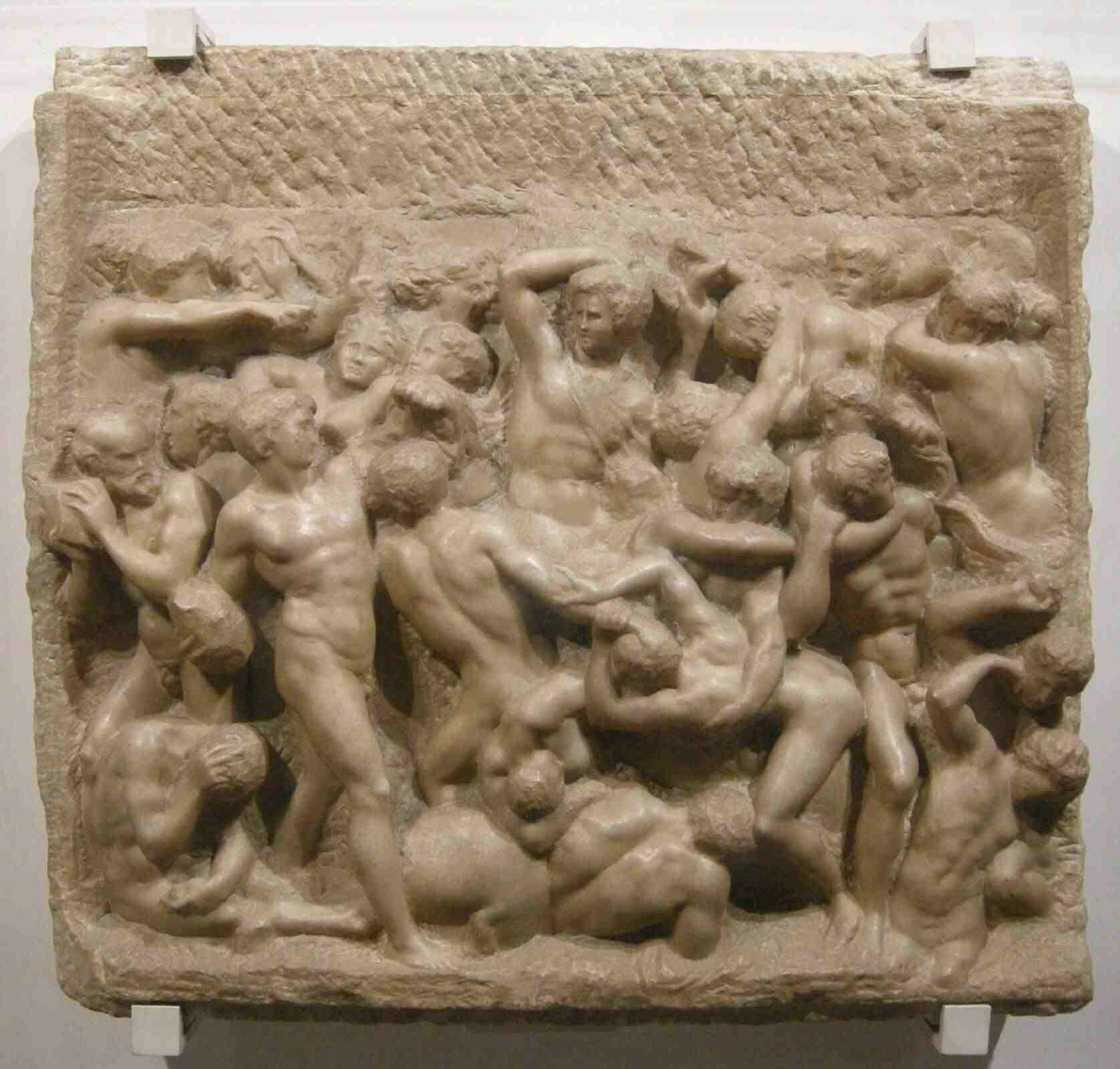
Location: Casa Buonarroti, Florence, Italy. Medium: Marble relief
Long before the Sistine Chapel helped him achieve global fame, Michelangelo was struggling with tightly packed humans. Battle of the Centaurs is an early relief of intense marble work with vigorous writhing figures locked in violent action. Arms, shoulders and torsos are so closely overlapped that it becomes astonishingly difficult to separate one from another.
The project was commissioned by Lorenzo de’ Medici, whose court embraced the young artist and facilitated his study of classical sculpture and literature. Contrary to the traditional method of reliefs that have well-defined strata, Michelangelo makes a dense field of motion. In places, portions of figures pop out from the marble. In others, they appear to be partially submerged in it.
The exact mythological identification of the narrative is disputed. Still, as that is its main artistic purpose, none of that is in any doubt: the human form. The rough surface also provides a unique insight into Michelangelo’s carving process. Casa Buonarroti believes the work was created around 1490–1492.
Why it matters: This youthful experiment anticipates the muscular complexity, dramatic movement, and anatomical ambition that define Michelangelo’s mature career.
7. Pietà – Michelangelo (1498–1499)
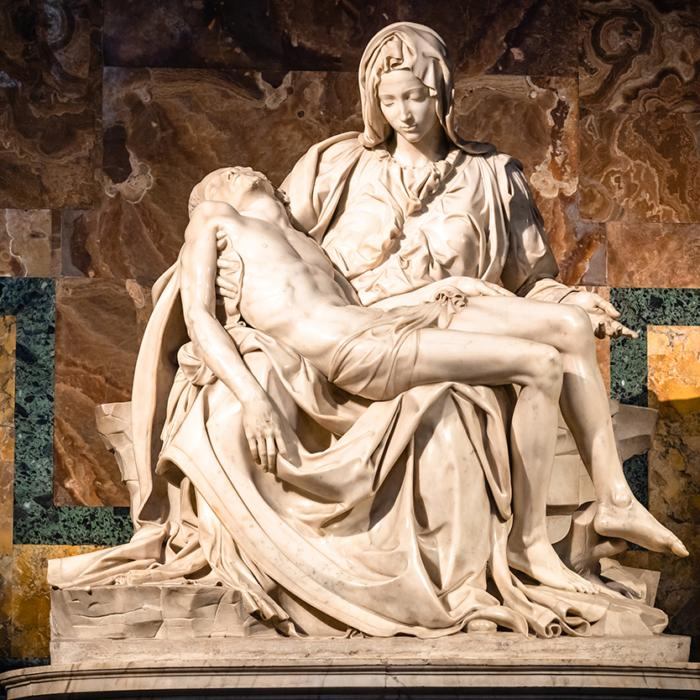
Location: St. Peter’s Basilica, Vatican City. Medium: Marble sculpture
Mother with the dead body of her son. Though the incident is wrenchingly mournful, Michelangelo’s Pietà communicates mourning through an exquisite stasis rather than effusive gestures. Mary is dressed in soft clothes, which gives a graceful, wide and firm composition. Next to those beautifully intricate folds, the smoothness and weightlessness of Christ’s body seem fragile.
Notice the striking contrast between the two figures. Michelangelo depicts Mary with the face of an impossibly early twenty-something, while Christ was painted with careful anatomical detail because physical death is real. The sculpture was commissioned for the funerary chapel in Rome of a French cardinal. This remarkable technical achievement launched Michelangelo’s career as an artist early in his life.
An especially unusual detail is the signature carved into Mary’s sash, a type of signature almost never found in Michelangelo’s surviving works. But the importance of that sculpture is more than craftsmanship. With its subdued sensibility, it invites introspection on themes of compassion, sacrifice and suffering’s interplay with religion.
Why it matters: The Pietà showed that Renaissance sculpture could harmonize physical precision and elevated form with deep spiritual emotion in a single marble work.
8. Moses – Michelangelo (c. 1513–1515)
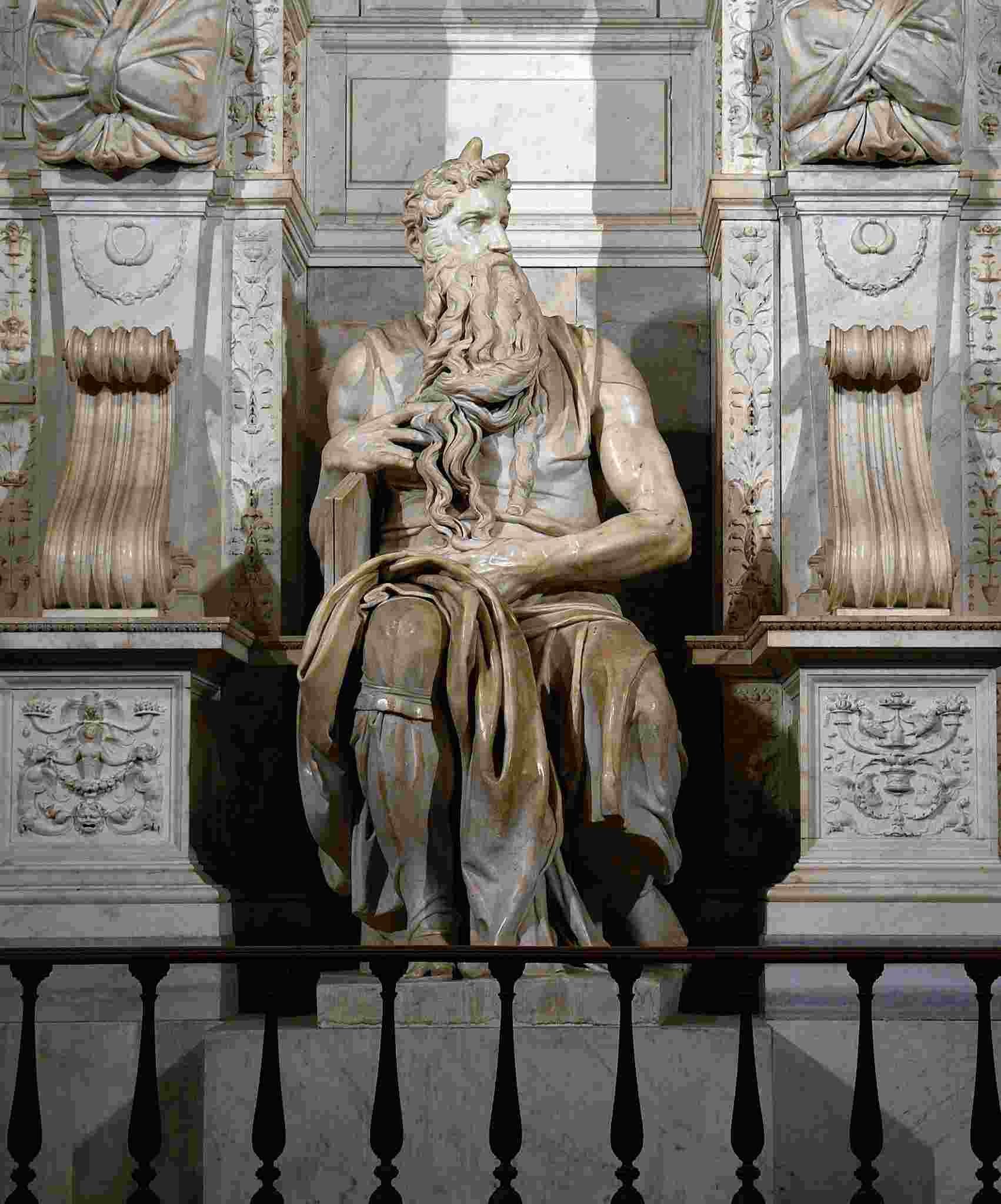
Location: San Pietro in Vincoli, Rome, Italy. Medium: Marble sculpture
Seeing Michelangelo masterpieces of Moses, he looks as if he’s sitting, but nothing about him seems to be resting. His big muscular arms, the furrow on his forehead, which shows concentration of purpose and the long flowing beard indicate an immense force momentarily restrained. It is among the most complex commissions undertaken by Michelangelo and was made for the tomb of Pope Julius II.
Moses Is Carrying the Tablets of the biblical commandments. His head is twisted, like he heard something outside of the sculpture. His head bears a pair of tiny horns, which probably would have been alarming to modern viewers. They express an older visual tradition linked to the Latin biblical description of the resplendent face of Moses.
The beard and fabric are arranged with precision to suggest Michelangelo’s versatility for articulating different textures in marble. The monument has gone through many iterations before being finalized. On the other hand, Moses remains an exemplary instance of how the sculptor might evoke dynamism in a stationary subject.
Why it matters: Moses converts physical restraint into psychological drama; here Michelangelo demonstrate their genius for expressive anatomy and monumental religious sculpture.
Read More: 15 Most Famous Northern Renaissance Artworks & Their Meanings
9. Madonna of Bruges – Michelangelo (c. 1501–1504)
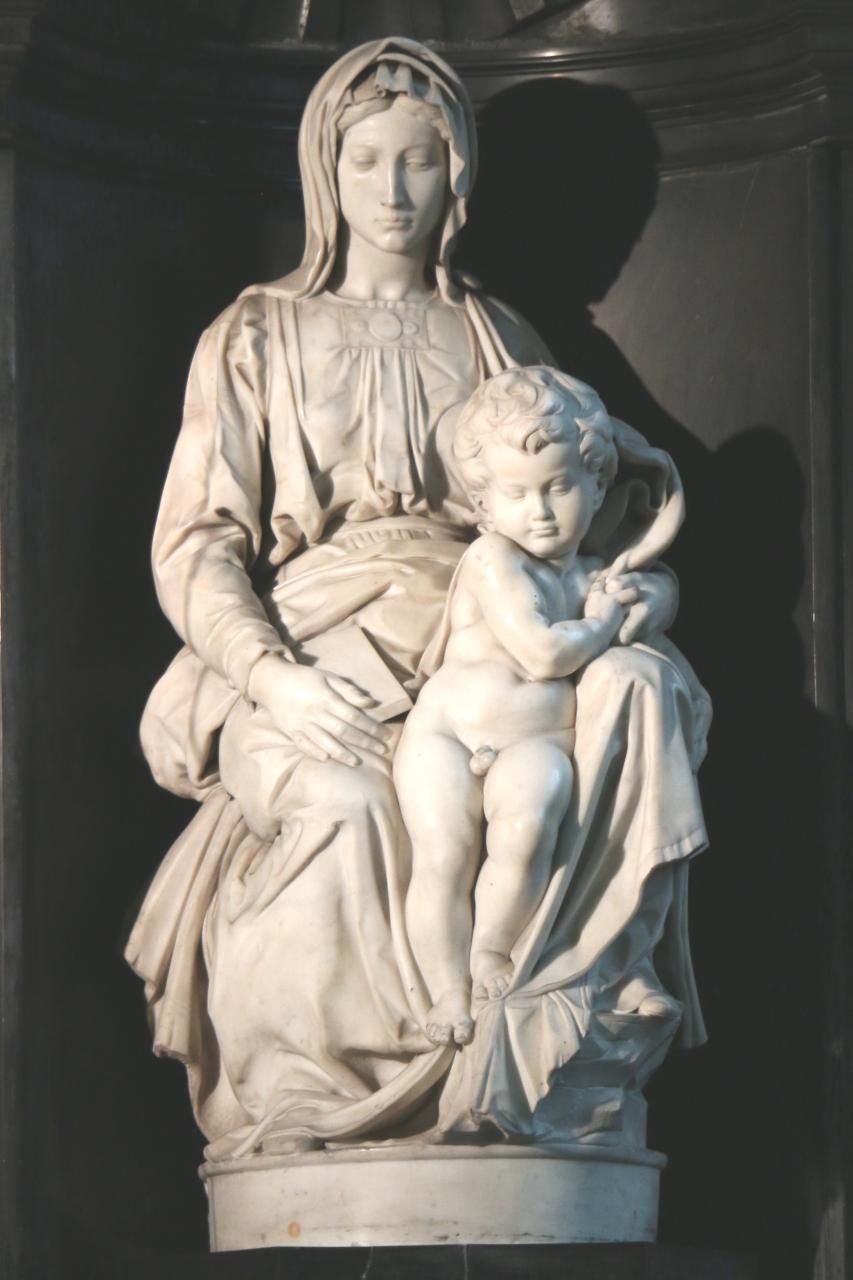
Location: Church of Our Lady, Bruges, Belgium. Medium: Marble sculpture
As shown in Michelangelo’s Madonna of Bruges, the Christ Child is strikingly more independent than he typically appears in traditional iconographies. The young Christ appears to be stepping away between Mary’s knees. Mary, however, gazes down, and she is said to appear pensive or possibly sad.
This sets up an engaging contrast in emotion. Movement toward the future as a child gains independence, but Mary lurks nearby, still and quiet with uncertainty. Michelangelo has also given the figures exceptional physical unity. Even in the child’s movement, a disturber of equilibrium to the composition, their bodies are compact.
By this time it had arrived in Bruges, where it became identified with the material wealth and international artistic connections of the city’s merchant class. Its presence outside Italy also illustrates just how prized Michelangelo’s work was beyond Florence and Rome.
Why it matters: Madonna of Bruges added a rare sensuality and emotional depth to an established religious theme, illustrating the wider influence of Italian Renaissance sculpture.
10. The Last Judgment – Michelangelo (1536–1541)

Location: Sistine Chapel, Vatican City. Medium: Fresco
The peaceful separation between heaven and earth disappears in Michelangelo’s The Last Judgment. Rather, a grotesquerie of human flesh is carried through the spectacle of salvation and damnation. The 16th-century fresco on the altar wall of the chapel was painted centuries after the ceiling frescoes in San Lorenzo, where Michelangelo created a design for tombs. Christ is at the center, surrounded by saints, angels and figures who await judgment.
Some of the bodies are being lifted to salvation; others plummet downward into horrible ambiguity. The busy composition gives an uneasy feel that is counter to the more stable arrangements of most Renaissance religious paintings. Examine the exaggerated musculature and twisting of the figures. Michelangelo literally uses the human body to depict spiritual crisis.
On the one hand, it’s a huge expose with rampant nudity and presentation of sacred subjects in unusual ways. Yet, the fresco soon took its place as one of the landmark artistic statements of sixteenth-century Rome. The Vatican Museums specify that it was carried out between 1536 and 1541.
Why it matters: The Last Judgment opened up the emotional and compositional range of monumental painting, paving a path to the dramatic force found in much later European art.
11. The Prisoners or Slaves – Michelangelo (c. 1519–1534)
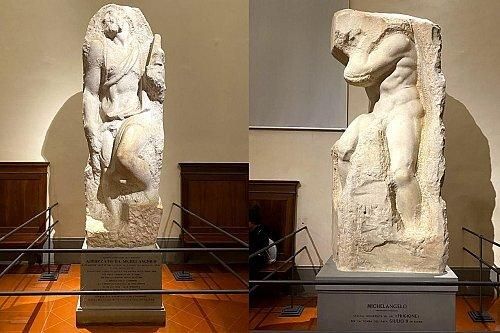
Location: Galleria dell’Accademia, Florence, Italy. Medium: Unfinished marble sculptures
None are more interesting perhaps than those by Michelangelo, which seem to wrestle with their own material. The Prisoners, or enslaved people, four unfinished sculptures, reveal muscular bodies emerging irregularly from rough blocks of marble. The heads, torsos and limbs are still partially encased in stone.
Their lack of completion generates an exceptional image. The figures appear to be entangled with the material surrounding them, rather than freely standing outside it. These sculptures were created in relation to the design for the tomb of Pope Julius II, which evolved and was altered, thus losing their completion.
Their incompletion also makes the artist’s process unusually legible. Where smooth surfaces meet rough chisel marks, you are tempted to fill in the idea of uncovering a figure out of the stone.
The sculptures have also inspired meditations on captivity, labor, and the relationship between artistic intention and physical matter. But their original symbolic functions should not be treated as fully resolved.
Why it matters: The unfinished Sculpture expresses. The Prisoners place Michelangelo’s creative process within the viewer’s experience.
12. The Dome of St. Peter’s Basilica – Michelangelo (Design from 1546)
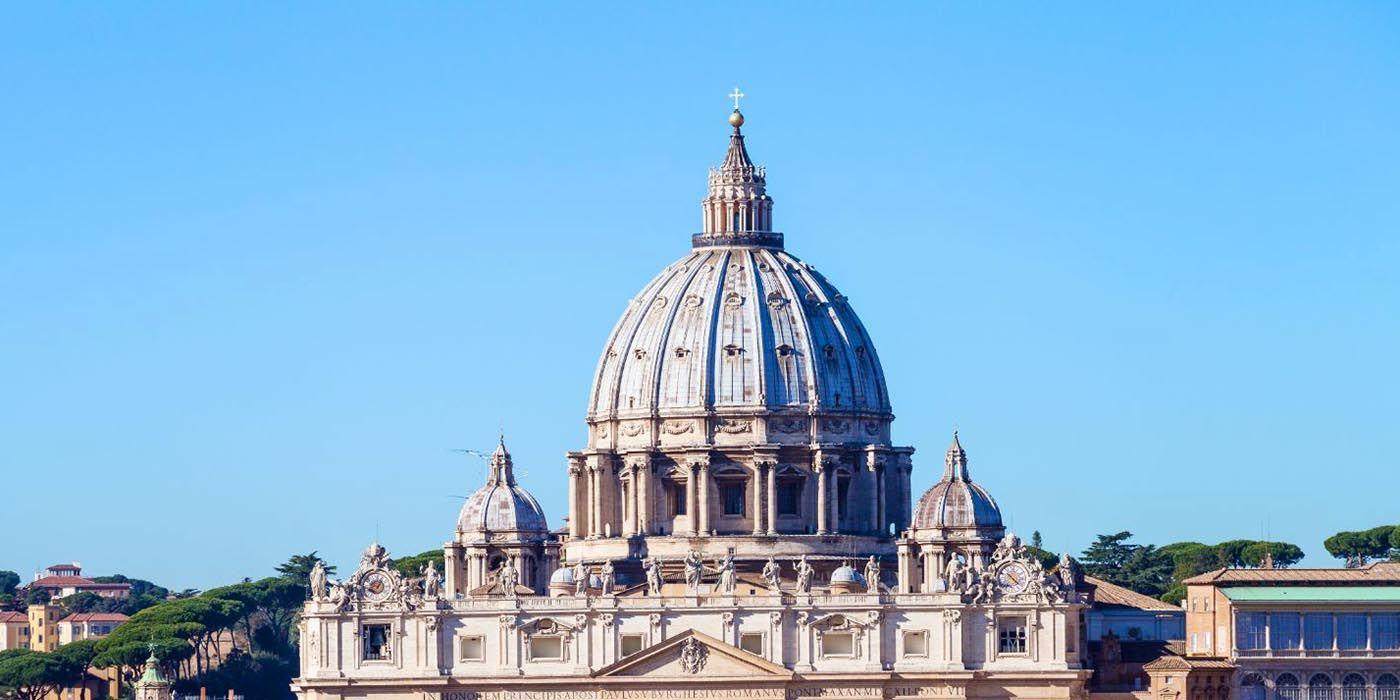
Location: St. Peter’s Basilica, Vatican City. Medium: Architectural design
Michelangelo dreamed of so much more than painting and sculpture. Later, he guided the reconstruction of one of Christianity’s iconic architectural projects. St. Peter’s Basilica has a dome that towers above Vatican City and is one of the iconic silhouettes visible throughout Rome.
In its strong structural forms, Art Deco embodied Michelangelo’s preoccupations with clarity, proportion, and sensational physical scale. And, like his sculptures, the architecture speaks of power through relationships that are carefully balanced among its parts. But it also demonstrates the collaborative spirit of Renaissance architecture.
Michelangelo took the design of the dome and supervised construction up to the drum. Following his death in 1564, Giacomo della Porta and Domenico Fontana built the structure but changed certain elements of its outline. So the final dome must not be viewed as Michelangelo’s achievement alone. However, his contribution was to its architecture and character.
Why it matters: Michelangelo’s monumental artistic imagination guided his designs for great works of architecture, and St. Peter’s dome became part of the visual identity of Rome for centuries to come.
Michelangelo’s Sculptures vs. Paintings: What Makes Them Different?
Another epithet that has been conferred on him is the “Father of Modern art”. This at its core succinctly expressed by how while Michelangelo dabbled in many artistic mediums, always was a central role for the human body. His sculptures draw the viewer into a consideration of corporeal weight, material resistance and motion. The tension of David’s stance expresses bravery. In The Prisoners, unfinished surfaces reveal interactions between stone and artistry.
Painting offered different possibilities. By using gesture and negative space, The Creation of Adam tells a deep biblical story. By contrast, Michelangelo masterpieces like The Last Judgment turn the hundreds of figures therein into a high drama of spiritual indecision. However, these media have their own commonality: robust physicalities, eloquent gesturality and a great capacity for embodied expression.
How Michelangelo Influenced Renaissance and Later Art
Michelangelo masterpieces were felt not just among the artists who actually worked in his lifetime. His approach to anatomy, first of all, prompted painters and sculptors to look boldly into the body. His numbers also showed how physical activity could convey both emotional and cerebral meaning.
His compositions were also instrumental in developments connected with Mannerism, particularly the taste for elongated bodies and unconventional poses. His monumental scale and dramatic treatment of subjects from the Bible were also influential on later artists. But his impact was more than just having muscular figures to imitate.
It was through Michelangelo that the notion that artistic invention, technical accomplishment and individual imagination could create masterpieces of uniquely high cultural relevance began to develop. Yeah, the idea that artistic invention, technical accomplishment and individual imagination could create masterpieces of uniquely high cultural relevance would begin to develop. Indeed, his legacy is not only of Renaissance art but the greater history of artistic experimentation.
Final Thoughts
Michelangelo’s artistic achievements cannot be reduced to marble statues or magnificent ceiling paintings. His career encompassed classical mythology, religious devotion, monumental architecture, and persistent experimentation with the human figure.
From the tense expression of David to the extraordinary movement of The Last Judgment, these 12 famous Michelangelo masterpieces reveal an artist who continually challenged established expectations.
Some works celebrate physical perfection, while others expose vulnerability or remain unfinished. Together, they demonstrate why Michelangelo remains one of the most influential figures in Western art history.
FAQs About Michelangelo Masterpieces
What is Michelangelo’s most famous masterpiece?
David and The Creation of Adam are among Michelangelo’s most recognizable works. The Pietà and Sistine Chapel ceiling are also celebrated internationally.
How many masterpieces did Michelangelo create?
Michelangelo produced numerous sculptures, paintings, architectural designs, and drawings. There is no universally accepted number of masterpieces because artistic importance involves interpretation.
Where can you see Michelangelo masterpieces?
Major works are displayed in Florence, Rome, and Vatican City. Important locations include the Accademia Gallery, Uffizi Galleries, and Sistine Chapel.
Why are Michelangelo’s sculptures so famous?
His sculptures combine sophisticated anatomical understanding, expressive poses, and technical precision. Additionally, they communicate psychological and religious themes through powerful physical forms.
How did Michelangelo masterpieces change Renaissance art?
Michelangelo expanded artistic possibilities through monumental compositions, expressive anatomy, and innovative sculpture. His influence also helped shape Mannerism and subsequent European artistic traditions.